




Technical Articles
2026.10.27
Topic 4 : Shielding Effectiveness (SE)
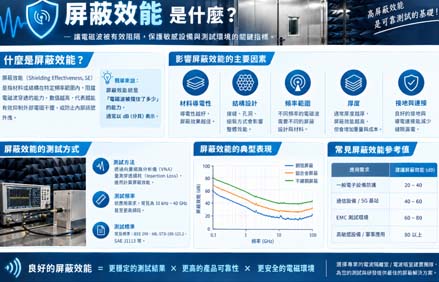
Typically used to measure the degree to which electromagnetic shielding (such as metal enclosures,
Anechoic Chambers, Shielded Rooms/Boxes, Conductive Fabric, Connectors) attenuates electromagnetic waves.
• Basic Concept: SE refers to the ratio of the electromagnetic field strength (or power) at a given location in space without shielding to the
electromagnetic field strength (or power) with shielding.
• Unit: Usually expressed in decibels (dB).
• Formula: SE = 20 log(E1/E2) or 20 log (H1/H2) (where E₁, H₁ are the electric/magnetic field strengths without shielding, and E₂, H₂ are the
strengths with shielding).
• Numerical Meaning: A higher decibel value indicates better shielding effectiveness. For example, a shielding effectiveness of 60 dB means that
approximately 99.99% of electromagnetic energy is attenuated or blocked.
• Common Standards: High-quality electromagnetic shielding chambers typically require a shielding effectiveness of ≥ 100 dB (within a specific
frequency range, such as 30 MHz ~ 18 GHz), meaning they can attenuate external electromagnetic wave energy to less than one billionth of its
original value.
Shielding effectiveness depends on several physical and structural conditions:
• Material Properties: The electrical conductivity, permeability, and thickness of the material.
• Incident Frequency: The frequency of the electromagnetic wave directly affects the reflection and absorption effects.
• Structural Integrity: Poor shielding design, gaps, or holes can lead to electromagnetic wave leakage and even worse resonance effects than
without shielding.