



Technical Articles
2026.10.27
Topic 3 : Why Need to Use Absorbing Materials in Anechoic Chambers?

The solutions of modern Anechoic Chamber: Hybrid Absorbers
Ferrite and pyramidal absorbers are the two most common electromagnetic wave absorbing materials
used in anechoic chambers for electromagnetic compatibility (EMC) testing. They operate on very
different principles and are often used together to achieve absorption across the entire frequency range.
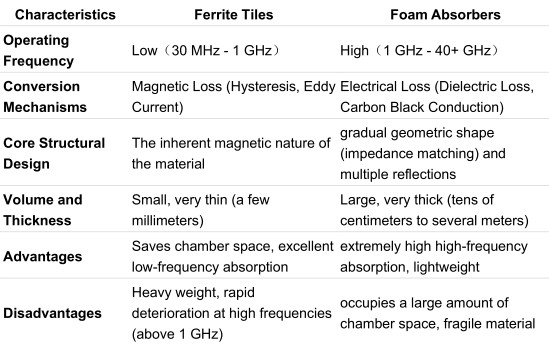
Below is a comparison of the principles and characteristics of these two absorbing materials:
1. Ferrite Absorber:
Ferrite is a magnetic ceramic material primarily used for low-frequency electromagnetic waves (typically 30 MHz to 1 GHz).• Absorption Principle (Magnetic Loss): When an electromagnetic wave is incident on a ferrite, its electromagnetic field interacts with
the magnetic dipole moment inside the ferrite. Electromagnetic wave energy induces hysteresis loss and eddy current loss within
materials, thus converting the electromagnetic wave energy into a small amount of heat that dissipates.
• Shape Characteristics: Typically made into thin, square, tile-like shapes (approximately 6mm thick), and relatively heavy.
2. Pyramidal Absorber:
Pyramidal absorbers are usually made of polyurethane foam impregnated with carbon black, primarily targeting high-frequency bands (1 GHz to tens of GHz or even higher).
• Absorption Principle (Impedance Matching and Electrical Loss):
• Impedance Matching (Geometric Structure): If an electromagnetic wave directly impacts a plane with high absorption, it will produce a large amount of reflection due to impedance mismatch. The apex of the pyramid faces the air, and its cross-sectional area gradually increases from the apex to the base, causing the equivalent impedance experienced by the electromagnetic wave to gradually
transition from the 377 ohms of air to the impedance within the material, thereby minimizing reflection.
• Electrical Loss: Electromagnetic waves entering the pyramid's interior induce conduction currents between carbon black particles,
converting electrical energy into heat energy through dielectric loss.
• Multiple Reflections: The pyramid's geometry causes electromagnetic waves not absorbed in one pass to be repeatedly reflected
between adjacent pyramid walls, increasing the number of times they come into contact with the material and further enhancing the
absorption rate.